PtBi₂: The Topological Superconductor That Breaks All Known Rules
A groundbreaking discovery in condensed matter physics reveals that the material platinum-bismuth-two (PtBi₂) exhibits a form of superconductivity never before observed. Unlike any known superconductor, PtBi₂ confines perfect, zero-resistance electron flow strictly to its outer surfaces while its interior remains a normal metal. Even more remarkably, the electrons on these surfaces pair up in a unique six-fold symmetric pattern, defying conventional theories and opening a direct pathway to creating Majorana particles, which are considered crucial for building fault-tolerant quantum computers.
The discovery of new superconducting materials often pushes the boundaries of physics, but the recent findings on platinum-bismuth-two (PtBi₂) represent a paradigm shift. This shiny gray crystal, as detailed in a landmark 2025 study published in Nature by researchers from Technische Universität Dresden and the Cluster of Excellence ct.qmat, hosts an electronic world that breaks fundamental rules long thought to be fixed. The material exhibits a rare phenomenon known as topological superconductivity, but with a twist so unusual it has left scientists both astonished and intrigued. This article explores the unique properties of PtBi₂, from its surface-only superconductivity to its unprecedented electron pairing and its direct implications for the future of quantum computing.
The Unusual Architecture of PtBi₂ Superconductivity
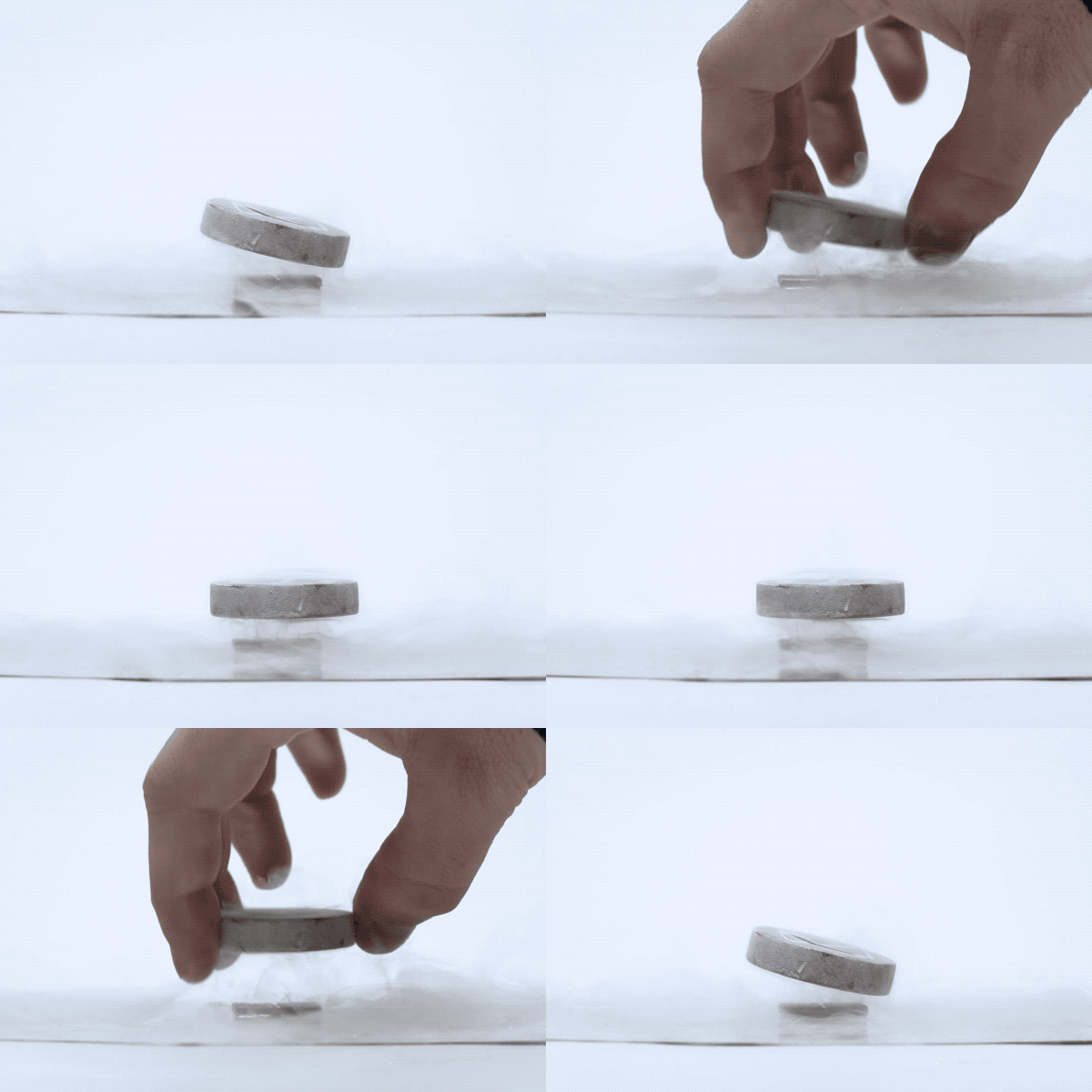
At the heart of PtBi₂'s novelty is its spatial structure. Researchers have confirmed that superconductivity—the ability to conduct electricity with zero resistance—is not a bulk property of the entire crystal. Instead, it is confined exclusively to the top and bottom atomic layers, creating what scientists describe as a "natural superconductor sandwich." The interior of the material remains a normal metal, where electrons experience resistance as they move. This confinement occurs due to a topological property of the material's electronic structure. Topological properties are exceptionally robust; they arise from the global symmetry of the crystal's atomic arrangement and remain stable unless the entire material's symmetry is fundamentally altered.
Topological Protection and Surface States
The electrons responsible for superconductivity are bound to the crystal's surfaces by these topological rules. A key feature is that the electrons on the top surface are always mirrored by corresponding electrons on the bottom surface. This pairing is intrinsic and persistent. Remarkably, if the crystal were cut in half, the newly exposed surfaces would immediately develop the same bound electron states. This robustness makes PtBi₂ a compelling candidate for practical applications, as its superconducting properties are not easily destroyed by minor imperfections.

A Never-Before-Seen Pattern of Electron Pairing
Superconductivity occurs when electrons form "Cooper pairs" that can move coherently without scattering. In PtBi₂, the mechanism behind this pairing is what truly sets it apart from all other known superconductors. High-resolution measurements led by Dr. Sergey Borisenko at the Leibniz Institute for Solid State and Materials Research (IFW Dresden) revealed a startling pattern. The electrons on the superconducting surface do not pair up uniformly. Instead, electrons moving in six specific, evenly spaced directions refuse to pair at all.
Breaking Symmetry Conventions
This six-fold restriction in pairing symmetry is unprecedented. In conventional superconductors, pairing is isotropic—it happens equally in all directions. Some high-temperature superconductors, like cuprates, exhibit directional pairing with a four-fold symmetry. PtBi₂ is the first material discovered where the superconducting pairing explicitly follows a six-fold symmetric pattern, directly reflecting the three-fold rotational symmetry of the atoms on its surface. "We have never seen this before," says Borisenko. The discovery challenges existing theoretical models, as the origin of this unique pairing mechanism is not yet understood.
Majorana Particles and the Path to Quantum Computing
Perhaps the most significant implication of PtBi₂'s properties is its direct connection to Majorana particles. These exotic quasi-particles, which act as their own antiparticles, are highly sought after in condensed matter physics because they are considered promising building blocks for topological quantum bits (qubits). Qubits based on Majoranas are theorized to be far more resistant to decoherence and noise than other types, a critical requirement for building practical, fault-tolerant quantum computers.
A Natural Host for Majoranas
The study confirms that the topological superconductivity in PtBi₂ naturally creates Majorana particles that are trapped along the physical edges of the crystal. "Our computations demonstrate that... we could artificially make step edges in the crystal, to create as many Majoranas as we want," explains Prof. Jeroen van den Brink, Director at IFW Dresden. This provides a new and practical material platform for generating and studying these particles, which have been elusive in other candidate systems.
Future Directions and Potential Control
With the fundamental properties identified, the next phase of research focuses on controlling them for technological use. Researchers are exploring strategies to isolate and manipulate the Majorana particles. One approach involves thinning the PtBi₂ crystal. This could transform the non-superconducting interior from a metal into an insulator, thereby preventing interference from ordinary electrons and creating a cleaner environment for Majorana-based qubits. Another strategy involves applying magnetic fields, which could potentially be used to move Majorana particles from the edges of the crystal to specific corners, a necessary step for performing quantum operations.
The discovery of PtBi₂'s rule-breaking superconductivity is more than a scientific curiosity; it is a material breakthrough with a clear trajectory toward application. By combining intrinsic topological protection with an unprecedented pairing mechanism and a direct link to Majorana particles, PtBi₂ has positioned itself at the forefront of the search for robust quantum computing materials. It challenges physicists to develop new theories while offering engineers a promising new tool. As research progresses to control its unique properties, PtBi₂ may well become a foundational component in the quantum technologies of tomorrow.