Read on nature.com
A New Era for Computing: Programmable Photonic Ising Machine Solves Complex Problems
Researchers have developed a groundbreaking programmable photonic Ising machine that operates at room temperature and solves complex optimization problems with unprecedented speed and scale. This Hopfield network-inspired architecture uses optoelectronic oscillators to handle up to 256 fully connected spins and over 41,000 sparse spins, achieving computational speeds exceeding 200 giga operations per second. The system demonstrates superior performance on challenging benchmarks including max-cut problems, number partitioning, and protein folding—tasks that have previously challenged photonic computing systems.
The landscape of computational problem-solving is undergoing a revolutionary transformation with the development of advanced photonic Ising machines. These specialized hardware systems offer a compelling approach to tackling NP-hard problems—complex computational challenges that become exponentially more difficult as they scale. Traditional digital computers struggle with such problems, but new photonic architectures inspired by neural networks and quantum mechanics are showing remarkable promise.
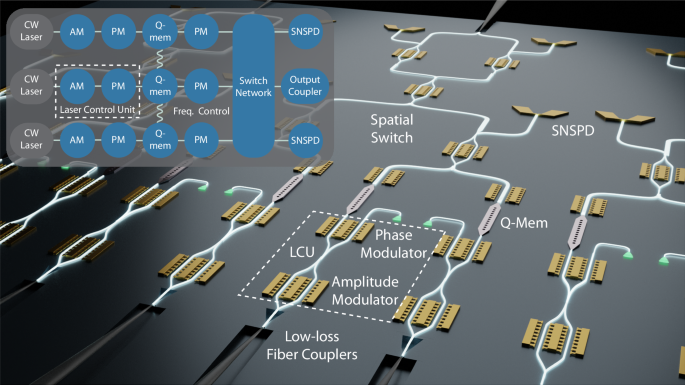
Recent research published in Nature introduces a programmable, stable, room-temperature optoelectronic oscillator (OEO)-based Ising machine that represents a significant leap forward in this field. Unlike quantum annealers that require cryogenic cooling and face scalability limitations, this photonic system operates at room temperature and demonstrates linear scaling in spin representation, making it both practical and scalable for real-world applications.
Architecture and Technical Innovation
The core innovation of this photonic Ising machine lies in its architecture, which draws inspiration from Hopfield networks—neural network models known for their associative memory capabilities. The system employs cascaded thin-film lithium niobate (TFLN) modulators, a semiconductor optical amplifier (SOA), and a digital signal processing (DSP) engine arranged in a recurrent time-encoded loop. This configuration enables the system to represent and manipulate spin states—the fundamental computational units in Ising models—with remarkable efficiency.
What sets this system apart is its impressive scalability. The architecture can handle fully connected problems with up to 256 spins (representing 65,536 couplings) and sparse problems with over 41,000 spins (205,000+ couplings). This represents the largest spin configuration achieved in an OEO-based photonic Ising machine to date, enabled by the system's high intrinsic speed and efficient design.
Performance and Applications
The computational performance of this photonic Ising machine is truly groundbreaking. The system demonstrates potential speeds exceeding 200 giga operations per second (GOPS) for spin coupling and nonlinearity operations. This speed advantage translates directly to practical problem-solving capabilities across multiple challenging domains.
Experimental results show best-in-class solution quality for max-cut problems across arbitrary graph topologies, including configurations with 2,000 and 20,000 spins. The system also successfully obtains ground-state solutions for number partitioning and lattice protein folding problems—benchmarks that have previously eluded photonic computing systems. These achievements demonstrate the system's versatility and effectiveness across different types of optimization challenges.
Key Technical Advantages
Several technical features contribute to the system's superior performance. The integration of digital signal processing—traditionally used in optical communications—within the optical computation framework enhances both convergence speed and solution quality. This innovative approach opens new frontiers in scalable, ultrafast computing for optimization, neuromorphic processing, and analog artificial intelligence applications.
The system also employs an interesting approach to problem-solving: it uses inherent noise from high baud rates to escape local minima and accelerate convergence. Rather than treating noise as a problem to be eliminated, the architecture leverages it as a computational resource, allowing the system to explore solution spaces more effectively and avoid getting stuck in suboptimal configurations.
Broader Implications and Future Directions
The development of this programmable photonic Ising machine represents more than just a technical achievement—it signals a shift in how we approach complex computational problems. By combining photonic hardware with intelligent algorithms and noise utilization strategies, researchers have created a system that bridges the gap between theoretical models and practical applications.
Looking forward, this technology has significant implications for fields ranging from logistics and scheduling to drug discovery and materials science. The ability to solve complex optimization problems quickly and efficiently could accelerate research and development across multiple industries. As the technology matures and becomes more accessible, we can expect to see photonic Ising machines playing an increasingly important role in solving some of humanity's most challenging computational problems.