Read on nature.com
Mars Reveals Its Solid Inner Core: A Seismic Discovery and Correction
In December 2025, the journal Nature published an author correction for a groundbreaking study that used seismic data to detect a solid inner core within Mars. The original research, published in September 2025, revealed a 600-kilometer solid core, fundamentally altering our understanding of the Red Planet's interior structure, evolution, and potential for past habitability. This article explains the significance of the discovery, the nature of the minor citation correction, and what this finding means for planetary science and the search for life beyond Earth.
The interior of Mars has long been a mystery, but recent seismic data has peeled back the layers of the Red Planet to reveal a surprising secret. In late 2025, the prestigious journal Nature published an author correction for a landmark study that first appeared in September of the same year. The core finding—both literally and figuratively—is the seismic detection of a solid inner core within Mars, measuring approximately 600 kilometers in radius. This discovery, led by researchers from the University of Science and Technology of China and the University of Texas at Austin, provides the most direct evidence yet for the structure of the Martian core, offering profound insights into the planet's formation, magnetic history, and thermal evolution.

The Seismic Breakthrough: Probing Mars's Heart
For decades, scientists have modeled the interior of Mars based on gravity data, orbital observations, and comparisons to Earth. The confirmation of a layered core structure, however, required direct seismic measurements. This data came from NASA's InSight lander, which recorded marsquakes—seismic events on Mars—from 2018 until its mission ended. By analyzing how seismic waves traveled through the planet, the international research team could distinguish between different layers. Waves that passed through the very center of Mars behaved in a way that was only consistent with a solid sphere, leading to the conclusion of a solid inner core surrounded by a liquid outer core.

Understanding the Author Correction
The December 2025 publication in Nature is labeled as an "Author Correction." It is crucial to understand that this correction does not alter the primary scientific conclusion about the Martian core. According to the correction notice, the change was specific to the "Methods" section of the original paper. The text describing the influence of elements like oxygen, carbon, and sulfur on core velocity and density incorrectly cited a reference (ref. 54). The authors have updated this to the correct reference, ref. 70, which is a 2023 study titled "Thermoelastic properties of liquid Fe-rich alloys under martian core conditions" published in Geophysical Research Letters. Such minor citation updates are common in scientific publishing and ensure the integrity and reproducibility of the methodological framework.
Implications for Mars and Planetary Science
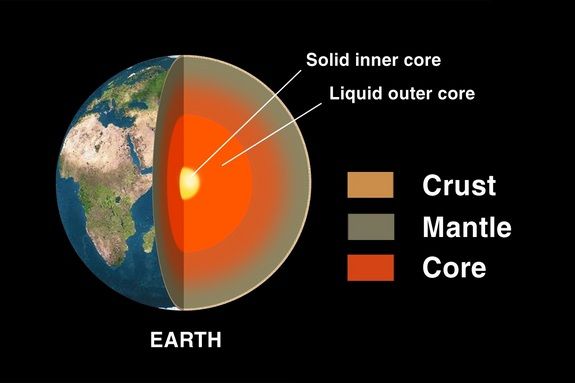
The detection of a solid inner core reshapes our narrative of Mars. A planet's core structure is a fossil record of its formation and cooling history. The presence of a solid inner core suggests Mars cooled sufficiently to allow the iron-nickel alloy at its center to crystallize. This has direct implications for the planet's now-defunct global magnetic field. On Earth, the convection of liquid metal in the outer core around a solid inner core generates our protective magnetic field. Mars likely had a similar dynamo early in its history, which faded as the core cooled. Understanding the size and state of the core helps scientists pinpoint when this magnetic shield collapsed, a key event that allowed solar radiation to strip away the Martian atmosphere and surface water, rendering the surface inhospitable.
Conclusion: A New Chapter in Martian Geology
The publication of this author correction underscores the meticulous and evolving nature of scientific discovery. The unchanging headline is that we now have robust seismic evidence for a 600-kilometer solid inner core within Mars. This finding moves planetary science from speculation to certainty regarding the Red Planet's deep interior. It provides a critical piece of the puzzle for understanding why Mars evolved so differently from Earth. As researchers continue to analyze the treasure trove of data from the InSight mission, this discovery will serve as a foundational reference for all future studies of Martian geology, climate history, and astrobiology. The heart of Mars is solid, and its story is now clearer than ever.