Read on Global News
Canada's Indo-Pacific Strategy Update: Navigating New Economic Realities in Asia
Foreign Affairs Minister Anita Anand has directed Global Affairs Canada to update the country's three-year-old Indo-Pacific strategy, citing the need to better reflect Canada's current economic ambitions and evolving relationships with key Asian partners. The Carney government's approach signals a shift toward economic pragmatism in foreign policy, with particular focus on resetting relations with both China and India. This strategic update comes as Prime Minister Mark Carney embarks on his first official trip to Asia, highlighting the region's growing importance to Canadian economic interests.
Foreign Affairs Minister Anita Anand has initiated a significant update to Canada's Indo-Pacific strategy, signaling a major shift in the country's approach to Asian relations. The original strategy, released three years ago under the Trudeau government, no longer aligns with Canada's current economic ambitions in the region or reflects the evolving dynamics with key partners like China and India.

Strategic Reassessment of Regional Policy
The decision to update the Indo-Pacific strategy comes at a critical juncture for Canadian foreign policy. According to reports from The Canadian Press, Anand has explicitly directed her department at Global Affairs Canada to undertake this comprehensive review. This move underscores the Carney government's commitment to refreshing Canada's international engagement framework to better serve contemporary economic and diplomatic objectives.
Evolving Relations with China and India
One of the most notable shifts in Canada's approach involves its stance toward China. The original strategy characterized Beijing as a "disruptive global power" whose values diverged from Canada's. However, Anand now describes China as a strategic partner, reflecting a significant recalibration of diplomatic positioning. This change in terminology and approach suggests a more pragmatic foreign policy that prioritizes economic cooperation while navigating complex geopolitical considerations.
Economic Pragmatism in Foreign Policy
Anand has emphasized that the Carney government brings an economic pragmatism to diplomacy that has been absent in recent years. This approach recognizes the growing importance of Asian markets to Canada's economic future and the need for strategic engagement that balances economic interests with broader foreign policy considerations. The updated strategy is expected to reflect this pragmatic orientation more explicitly than its predecessor.
Timing and Regional Focus
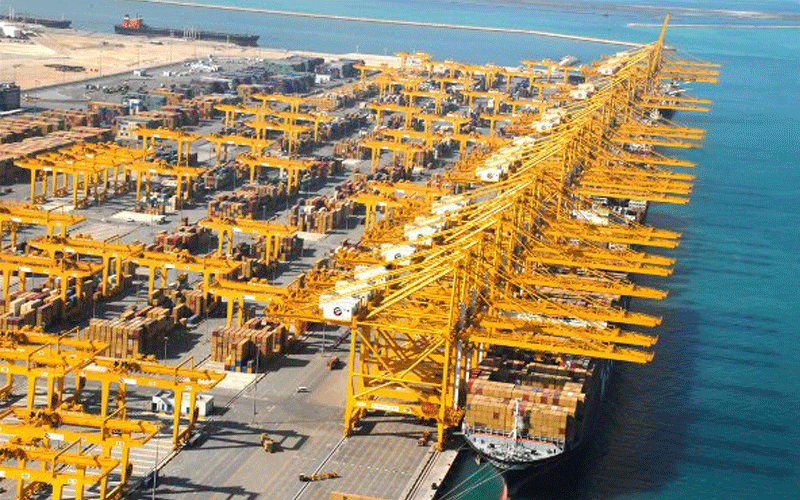
The strategy update coincides with Prime Minister Mark Carney's first official trip to Asia, highlighting the region's renewed importance in Canada's foreign policy agenda. Additionally, Anand has indicated that her next regional focus will be the Gulf, with Carney planning to visit the United Arab Emirates next month. This suggests a broader recalibration of Canada's engagement with key economic regions beyond the Indo-Pacific.

Conclusion: A New Chapter in Canadian Diplomacy
The decision to update Canada's Indo-Pacific strategy represents more than just a routine policy review—it signals a fundamental shift in how the Carney government approaches international relations. By prioritizing economic pragmatism and recalibrating relationships with key Asian partners, Canada is positioning itself to navigate the complex geopolitical landscape more effectively. As the updated strategy takes shape, it will be crucial to monitor how these diplomatic adjustments translate into concrete economic benefits and strengthened international partnerships for Canada.