The Global Wave of Gen Z Protests: From Andes to Himalayas
A new wave of youth-led protests is sweeping across continents from Madagascar to Nepal, driven by generational discontent against governments and political establishments. These mostly leaderless movements, primarily composed of Generation Z, are united by shared frustrations with corruption, economic inequality, and unresponsive political systems. Despite diverse local grievances, protesters are finding common ground through digital platforms and shared symbols, creating a global network of resistance that transcends national borders.
From the Andes to the Himalayas, a new wave of protests is unfolding across the world, driven by generational discontent against governments and anger among young people. This global phenomenon represents a significant shift in how younger generations are engaging with political systems and expressing their frustrations with traditional governance structures.

The Global Protest Movement
This week, Madagascar's President Andry Rajoelina was forced out of power and out of the country after a military mutiny, the culmination of weeks of demonstrations led by young protesters referring to themselves as "Gen Z Madagascar." The rage against the political establishment in the Indian Ocean island country mirrors other recent protests across the world, in countries like Nepal, the Philippines, Indonesia, Kenya, Peru and Morocco.
These protests have been sparked by specific grievances but are driven by long-simmering issues like widening inequality, economic uncertainty, corruption, and nepotism of leaders. They have one thing in common: Mostly leaderless, they are made up primarily of young people who brand themselves as "Gen Z," defined as those born roughly between 1996 and 2010 — the first generation to grow up entirely in the internet age.
Shared Grievances and Demands
According to analysis from The Associated Press, what connects these youth-led protests is a shared sense that traditional political systems aren't responsive to their generation's concerns, whether that's corruption, climate change, or economic inequality. Protest then becomes the logical outlet when institutional channels feel blocked.
Though their specific demands differ, most of these protests have been sparked by government overreach or neglect. Some have also confronted harsh treatment by security forces and brutal repression. In Morocco, a leaderless collective called Gen Z 212 — named after Morocco's dialing code — has taken to the streets to demand better public services and increased spending on health and education.
Cultural Symbols and Unity
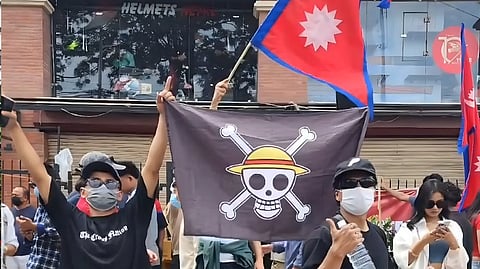
Across multiple countries, a singular pop culture symbol has emerged: a black flag showing a grinning skull and crossbones wearing a straw hat. The flag comes from a cult Japanese manga and anime series called "One Piece," which follows a crew of pirates as they take on corrupt governments. In Nepal, protesters hung the same flag on the gates of the Singha Durbar, the seat of the Nepalese government, and on ministries, many of which were torched in protests.
It was also hoisted by crowds in Indonesia, the Philippines, Morocco and Madagascar. Last week in the Peruvian capital, Lima, 27-year-old electrician David Tafur stood with the same flag in San Martín Square, now the stage for weekly protests. "We're fighting the same battle — against corrupt officials who, in our case, are also killers," he said, recalling that President Dina Boluarte's government held on to power since December 2022 despite more than 500 protests and the deaths of 50 civilians.
Digital Mobilization Strategies
Many significant protests in the past, like Occupy Wall Street in 2011, the Arab Spring between 2010 and 2012, and the 2014 Umbrella Revolution in Hong Kong, have been led by younger people. While they also used the internet and social media for mass mobilization, the "Gen Z" protesters are taking it to another level.
Digital platforms are powerful tools for information sharing and building connections, but the most effective movements often combine digital mobilization with traditional in-person organizing. Days before the deadly protests began in Nepal, the government announced a ban on most social media platforms for not complying with a registration deadline. Many young Nepalese viewed it as an attempt to silence them and began accessing social media sites through virtual private networks to evade detection.

Over the next few days, they used TikTok, Instagram and X to spotlight the lavish lifestyles of politicians' children, highlighting disparities between Nepal's rich and poor, and announce planned rallies and venues. Later, some of them also used the gaming chat platform Discord to suggest who to nominate as an interim leader for the country.
Global Impact and Future Implications
The protests in Nepal awakened not only the youth but also other generations. As one protester noted, "We realized that we are global citizens and the digital space connects us all and plays a powerful role across the world." This global connectivity represents a fundamental shift in how protest movements can coordinate and inspire each other across continents.
The emergence of these simultaneous youth-led movements across diverse geographical and cultural contexts suggests a broader transformation in political engagement among younger generations. As traditional political channels continue to fail in addressing their concerns, this wave of protests may represent the beginning of a more sustained global movement for political change.