Explosive CO₂ Ice Blocks: The Mystery Behind Mars' Mysterious Gullies
Scientists have solved the mystery of Mars' strange gullies through groundbreaking laboratory experiments revealing that blocks of frozen carbon dioxide carve these formations as they slide and sublimate. Utrecht University researchers successfully replicated Martian conditions to demonstrate how CO₂ ice blocks dig trenches with explosive gas pressure, creating worm-like channels that match those observed on the Red Planet. This discovery provides crucial insights into the unique geological processes shaping alien landscapes and deepens our understanding of Mars' dynamic surface evolution.
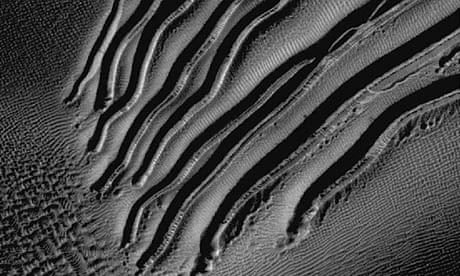
For years, the mysterious gullies carved into Martian dunes have puzzled planetary scientists, with their origin remaining one of the planet's enduring geological mysteries. Recent breakthrough research from Utrecht University has finally revealed the surprising mechanism behind these formations: explosive blocks of frozen carbon dioxide that behave like burrowing creatures as they slide down Martian slopes.
The Sublimation Process on Mars
The key to understanding this phenomenon lies in the unique atmospheric conditions of Mars and the behavior of carbon dioxide ice. During the Martian winter, temperatures plummet to around minus 120 degrees Celsius, causing CO₂ to freeze and accumulate on dune surfaces in layers up to 70 centimeters thick. As spring approaches and the sun warms the slopes, large ice blocks—sometimes measuring a meter in length—break loose and begin their descent.
What happens next is a process that doesn't occur naturally on Earth. Mars' thin atmosphere creates a sharp temperature difference between the warm sand and the cold ice blocks. This causes the underside of the blocks to instantly transform from solid ice directly into gas through sublimation. Since gas occupies significantly more space than solid ice, pressure builds rapidly beneath the blocks, creating what researchers describe as an explosive effect.

Laboratory Breakthrough
Dr. Lonneke Roelofs of Utrecht University led the groundbreaking research that finally demonstrated this process in action. Working with master student Simone Visschers at the Open University's specialized Mars chamber facility in Milton Keynes, the team recreated Martian conditions to observe the ice block behavior directly. "It felt like I was watching the sandworms in the film Dune," Roelofs remarked, describing the eerie, worm-like movements of the ice blocks as they carved through simulated Martian terrain.
The researchers experimented with various slope angles until they found the right conditions where CO₂ ice blocks began digging into the slope and moving downward. The blocks became trapped in hollows surrounded by small ridges of settled sand, continuing to sublimate and blast sand in all directions as they gradually slid downhill. The resulting artificial gullies matched almost exactly with those observed on Mars, confirming the long-suspected mechanism.
Geological Implications
This discovery represents a significant advancement in our understanding of Martian landscape formation. Unlike previous research that showed sublimating CO₂ ice could trigger debris flows along crater walls, these gullies formed through a different process entirely. The explosive sublimation-induced particle transport creates distinctive sinuous channels with characteristic ridges on either side, explaining formations that have baffled scientists for years.

The research, published in Geophysical Research Letters, demonstrates how studying other planetary surfaces can provide new frameworks for understanding geological processes. As Roelofs explains, "Conducting research into the formation of landscape structures of other planets is a way of stepping outside the frameworks used to think about the Earth. This allows you to pose slightly different questions, which in turn can deliver new insights for processes here on our planet."
The findings not only solve a specific Martian mystery but also contribute to broader questions about planetary evolution and the potential for extraterrestrial processes that operate differently from those on Earth. As we continue to explore our nearest planetary neighbor, such discoveries highlight the importance of laboratory simulations in understanding alien landscapes that we cannot yet visit in person.