Quantum Bayes' Rule: A 250-Year-Old Equation Gets a Quantum Makeover
An international team of physicists has successfully derived a quantum version of Bayes' rule, bridging classical probability theory with quantum mechanics. By applying the principle of minimum change to quantum states, researchers from the National University of Singapore, Hong Kong University of Science and Technology, and Nagoya University have validated the Petz map as the mathematical foundation for quantum Bayesian updating. This breakthrough connects quantum fidelity measures with classical probability reasoning, potentially advancing quantum computing, error correction, and machine learning applications.
In a groundbreaking development that connects classical probability theory with quantum mechanics, an international team of physicists has successfully derived a quantum version of Bayes' rule from first principles. This achievement represents a significant advancement in mathematical physics, bringing a 250-year-old probability framework into the quantum realm and potentially opening new avenues for quantum computing and machine learning applications.

The Classical Foundation: Bayes' Rule
Bayes' rule, first introduced by Thomas Bayes in 1763, provides a systematic method for updating beliefs based on new evidence. The rule treats probabilities as measures of belief rather than absolute facts, allowing for rational decision-making under uncertainty. As explained in the research published in Physical Review Letters, this framework underpins countless modern applications from medical testing and weather forecasting to data science and artificial intelligence.
The Quantum Breakthrough
The international research team, comprising Professor Valerio Scarani from the National University of Singapore, Assistant Professor Ge Bai from the Hong Kong University of Science and Technology, and Professor Francesco Buscemi from Nagoya University, approached the problem by applying the principle of minimum change to quantum systems. This principle ensures that beliefs are updated in the smallest possible way that remains compatible with new information, mathematically minimizing the distance between initial and updated states.

Quantum Fidelity and the Petz Map
In their quantum approach, the researchers quantified change using quantum fidelity, which measures the closeness between quantum states. By maximizing fidelity between forward and reverse processes, they derived equations that matched the Petz recovery map, a mathematical concept proposed by Dénes Petz in the 1980s. Professor Scarani noted that this represents the first derivation of the quantum Bayes' rule from a higher physical principle, validating the use of the Petz map for quantum applications.
Implications and Future Applications
This quantum version of Bayes' rule has significant implications for quantum computing, particularly in areas such as quantum error correction and quantum machine learning. The connection between quantum fidelity and classical probability reasoning provides a unified framework that could enhance our ability to process quantum information and make predictions in quantum systems. The research team plans to explore whether applying the minimum change principle to other quantum measures might reveal additional solutions and applications.
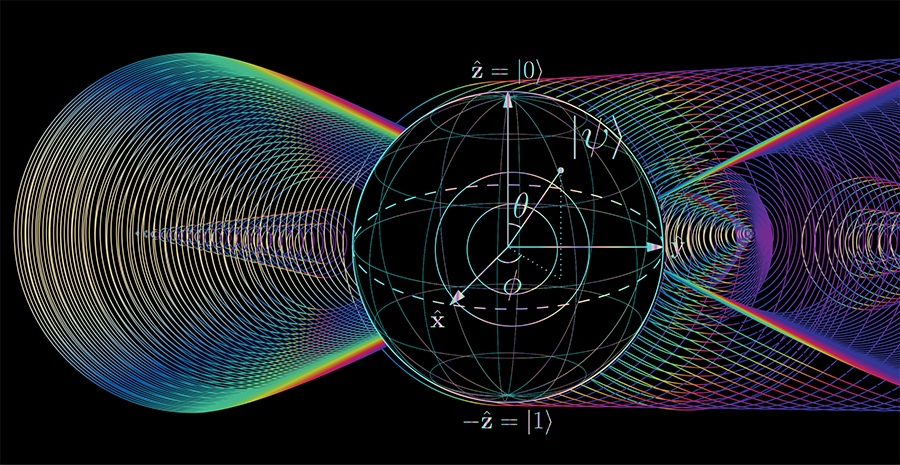
The development of a quantum Bayes' rule represents a fundamental advancement in our understanding of how probability and quantum mechanics intersect. By bridging classical reasoning with quantum reality, this research opens new possibilities for quantum technologies while demonstrating the enduring relevance of Bayesian principles in cutting-edge scientific discovery.