Read on the Guardian
South Korea's Former President Yoon Suk Yeol Sentenced to Life for Insurrection
In a landmark ruling, a South Korean court has sentenced former President Yoon Suk Yeol to life imprisonment with hard labor for leading an insurrection through his failed martial law declaration in December 2024. The Seoul Central District Court found Yoon guilty of attempting to disrupt the constitutional order by mobilizing troops to blockade the National Assembly and arrest political opponents. This historic verdict marks the first time an elected head of state in South Korea's democratic era has received the maximum custodial sentence, representing a significant moment for the nation's judicial system and democratic institutions.
In a historic ruling that has captured national and international attention, South Korea's judiciary has delivered a decisive verdict on one of the most significant political crises in the country's modern democratic history. The sentencing of former President Yoon Suk Yeol to life imprisonment with hard labor represents a watershed moment for South Korea's constitutional order and the resilience of its democratic institutions. This article examines the court's findings, the events leading to this unprecedented sentence, and the broader implications for South Korean politics and society.

The Court's Ruling and Legal Basis
The Seoul Central District Court delivered its verdict on Thursday, finding Yoon Suk Yeol guilty of leading an insurrection—a charge that carries three possible penalties under South Korean law: death, life imprisonment with labor, or life imprisonment without labor. Judge Jee Kui-youn, presiding over the case, determined that Yoon's declaration of martial law on December 3, 2024, constituted a deliberate attempt to disrupt the constitutional order. The court specifically noted that the purpose was "to send troops to the national assembly to blockade the assembly hall and arrest key figures, including the assembly speaker and party leaders, thereby preventing lawmakers from gathering to deliberate or vote."
In reaching its decision, the court considered several aggravating factors, including Yoon's lack of apology throughout the proceedings, his unjustified refusal to attend hearings, and what the judgment described as "massive social costs" inflicted on South Korean society. The ruling emphasized that the martial law declaration "greatly damaged the political neutrality of the military and police" and caused South Korea's "political standing and credibility in the international community to decline," leaving society "politically divided and experiencing extreme confrontation."
The December 2024 Crisis
The charges stem from events on the night of December 3, 2024, when prosecutors alleged that Yoon attempted to use military force to paralyze the legislature, arrest political opponents, and seize control of the national election commission. According to court documents and reporting from The Guardian, Yoon claimed he was rooting out "anti-state forces" and alleged election fraud without providing evidence. The crisis unfolded rapidly, with 190 lawmakers breaking through military and police cordons within hours to pass an emergency resolution lifting martial law.

Parliament moved swiftly in response to the crisis, impeaching Yoon within 11 days of the martial law declaration. The Constitutional Court removed him from office four months later, setting the stage for the criminal proceedings that culminated in Thursday's verdict. The court noted that while the crime was grave, Yoon's planning "did not appear meticulous," he had "attempted to limit the use of physical force," and most of his plans ultimately failed—factors that contributed to the decision to impose life imprisonment rather than the death penalty sought by prosecutors.
Historical Context and Legal Precedents
Judge Jee Kui-youn's ruling included a historical digression that traced the history of insurrection law, citing the 1649 execution of England's Charles I—who led troops into parliament—to establish that even heads of state can commit insurrection by attacking the legislature. This historical reference underscores the gravity with which the court viewed Yoon's actions and their threat to democratic governance.
The verdict follows a series of related rulings that formally established the events of December 3, 2024, constituted an insurrection. In January, former Prime Minister Han Duck-soo received a 23-year prison sentence in a ruling that described the martial law attempt as a "self-coup" by elected power that was "more dangerous than traditional uprisings." On February 12, former Interior Minister Lee Sang-min was jailed for seven years for his role in the insurrection, including relaying Yoon's orders to cut power and water to media outlets. Legal experts noted that these earlier rulings created a sentencing environment that made severe punishment more likely in Yoon's case.
Political and Social Reactions
The verdict elicited strong reactions across South Korea's political spectrum. Outside the courthouse, hundreds of Yoon supporters—waving South Korean and U.S. flags and chanting "Yoon again"—initially cheered when the judge dismissed some prosecution evidence but turned hostile as the ruling progressed. Some supporters shouted "political judge, step down" and hurled profanities at journalists. When the sentence was announced, some collapsed in tears, crying "the country is finished."
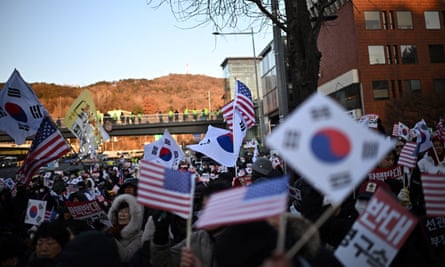
Approximately 500 meters away from the courthouse, progressive groups erupted in cheers and embraced one another, though some expressed disappointment that the death penalty had not been imposed. The divided reactions reflect the deep political polarization that has characterized South Korean society since the martial law crisis. The court itself acknowledged this division, noting in its judgment that Yoon's actions left society "politically divided and experiencing extreme confrontation."
Legal Proceedings and Future Implications
Yoon's legal team released a statement calling the verdict "a predetermined conclusion" and a "show trial," saying they could not bring themselves to respect the judgment. They accused the judiciary of "kneeling to incited public opinion and political power" and applying double standards, pointing to President Lee Jae Myung's suspended trials and opposition politicians acquitted on illegal evidence grounds. The legal team vowed to fight "to the end," saying truth would eventually be revealed "in the court of history." Yoon is expected to appeal the verdict.
Under South Korean law, life imprisonment carries no fixed release date, with parole theoretically possible after 20 years upon demonstration of good conduct and remorse. The court also sentenced seven co-defendants in related proceedings: former Defense Minister Kim Yong-hyun to 30 years; former intelligence commander Noh Sang-won to 18 years; former police chief Cho Ji-ho to 12 years; former Seoul police chief Kim Bong-sik to 10 years; and police commander Mok Hyun-tae to three years. Two defendants, Kim Yong-gun and Yoon Seung-young, were acquitted.
Broader Significance for South Korean Democracy
This verdict represents a critical test for South Korea's democratic institutions and the principle that no individual—including a sitting president—is above the law. The court's willingness to hold a former head of state accountable for attempting to subvert constitutional order sends a powerful message about the strength of South Korea's judicial independence and commitment to democratic norms.
The ruling also places Yoon Suk Yeol in the historical context of South Korean leaders who have faced legal consequences after leaving office. Every South Korean president who has served a prison sentence has ultimately been pardoned—including former President Park Geun-hye, who was initially sentenced to a combined 32 years in prison for corruption and related offenses in 2018 before receiving a presidential pardon in 2021. In 1996, military dictators Chun Doo-hwan and Roh Tae-woo received death and 22-and-a-half-year sentences, respectively, for their roles in a 1979 coup and subsequent massacre in Gwangju, though both were eventually pardoned.
As South Korea processes this historic verdict, the nation faces ongoing challenges of political reconciliation and institutional trust-building. The court's judgment represents both a conclusion to a specific legal case and a beginning for broader conversations about democratic resilience, constitutional order, and the relationship between political power and legal accountability in one of Asia's most vibrant democracies.