Barbara Rose Johns Statue Replaces Robert E. Lee in U.S. Capitol, Honoring a Teen Civil Rights Pioneer
The U.S. Capitol has unveiled a statue of Barbara Rose Johns, a 16-year-old who led a 1951 student strike against segregated school conditions in Virginia. The statue replaces a monument to Confederate General Robert E. Lee, marking a significant shift in the figures chosen to represent the state. Johns's protest became a catalyst for the landmark Brown v. Board of Education Supreme Court case. The installation ceremony, attended by bipartisan leaders and Johns's family, highlights her enduring legacy in the fight for educational equality.
The U.S. Capitol has taken a historic step in redefining its symbolic landscape, replacing a statue of Confederate General Robert E. Lee with a monument to a teenage civil rights hero. The new statue honors Barbara Rose Johns, who at just 16 years old led a pivotal student protest against the deplorable conditions of her segregated Virginia high school in 1951. This change represents more than an artistic substitution; it is a profound statement on national values, historical memory, and the ongoing journey toward racial justice.
The Unveiling Ceremony and Bipartisan Recognition
The statue was officially unveiled in the Capitol's Emancipation Hall in a ceremony that underscored the broad, bipartisan respect for Johns's legacy. The event featured prominent leaders including Republican House Speaker Mike Johnson, Democratic Minority Leader Hakeem Jeffries, and Virginia Governor Glenn Youngkin. Speaker Johnson framed the moment as an honor for "one of America's true trailblazers," a woman who embodied the fight for "liberty and justice and equal treatment under the law." The ceremony was deeply personal, with over 200 members of Johns's family in attendance and musical performances that reflected the spirit of the civil rights movement.
Barbara Rose Johns: The Student Strike That Changed History
In 1951, Barbara Rose Johns was a student at the segregated R.R. Moton High School in Farmville, Virginia. She and her classmates endured overcrowded, dilapidated facilities, a stark contrast to the well-maintained schools for white students in the same county. Frustrated by the injustice, Johns organized and led a student strike, mobilizing hundreds of her peers to protest the inequitable "separate but equal" doctrine. Her courageous action was not merely a local grievance; it became a national catalyst. The NAACP took up the students' cause, filing a lawsuit that was eventually consolidated into the landmark Brown v. Board of Education case. The Supreme Court's 1954 decision in that case declared state-sanctioned school segregation unconstitutional, fundamentally altering American society.

Symbolism of the Statue and Its Message
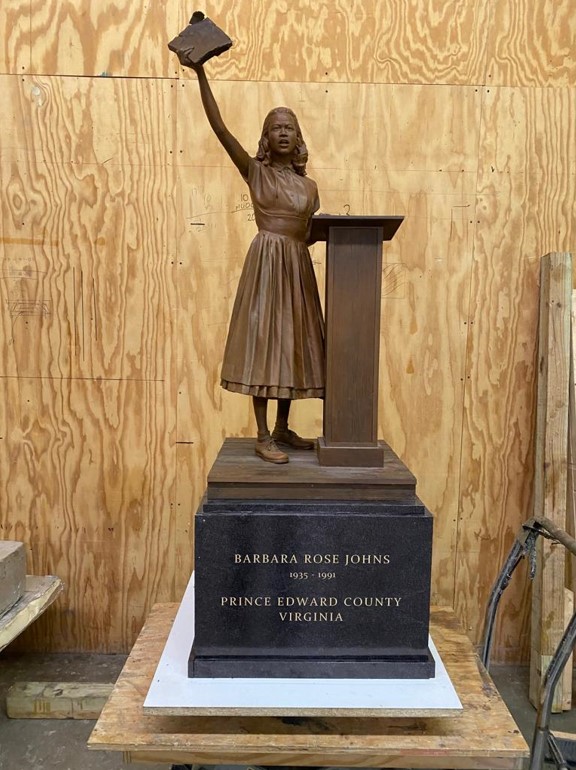
The statue itself, sculpted by Steven Weitzman, is a powerful representation of Johns's defiance and hope. It depicts the young activist standing beside a lectern, holding a tattered textbook aloft. This gesture symbolizes both the poor condition of the educational materials provided to Black students and the lifting of knowledge as a tool for liberation. The pedestal is engraved with a poignant question Johns posed:
"Are we going to just accept these conditions, or are we going to do something about it?"It also features a biblical quote, "And a little child shall lead them," from the Book of Isaiah, highlighting the profound impact of youth leadership.
Replacing a Symbol of Division
The removal of the Robert E. Lee statue in December 2020 was part of a national reckoning with Confederate monuments following the murder of George Floyd. That statue had represented Virginia in the Capitol for 111 years. Its replacement with Johns's statue transforms Virginia's contribution to the National Statuary Hall Collection from a symbol of rebellion and slavery to one of courage and the pursuit of equality. As Minority Leader Hakeem Jeffries stated at the ceremony, Virginia is now represented by "an actual patriot who embodied the principle of liberty and justice for all, and not a traitor who took up arms against the United States to preserve the brutal institution of chattel slavery."
A Lasting Legacy
Barbara Rose Johns's legacy extends far beyond this single statue. After her protest, she became a librarian in the Philadelphia public school system, raising five children. She passed away in 1991. Her story is also commemorated at the Virginia Civil Rights Memorial in Richmond, and her former high school is preserved as a National Historic Landmark and museum. The installation of her statue in the U.S. Capitol ensures that her story of youthful courage and its pivotal role in dismantling legal segregation will be told to generations of visitors, serving as an enduring inspiration in the nation's most symbolic building.