The Microchip Revolution in Quantum Computing: A Tiny Device with Massive Potential
A breakthrough from the University of Colorado at Boulder and Sandia National Laboratories introduces a microchip-sized optical phase modulator that could dramatically accelerate quantum computing. This device, nearly 100 times thinner than a human hair, controls laser frequencies with extreme precision while using 80 times less power than current systems. Crucially, it's manufactured using standard CMOS fabrication, enabling mass production and paving the way for quantum computers with thousands or millions of qubits. This innovation addresses key scalability challenges and moves the field closer to practical, large-scale quantum machines.
The landscape of quantum computing is on the verge of a transformative shift, moving from bulky, custom-built laboratory setups to scalable, chip-based systems. A recent breakthrough from researchers at the University of Colorado at Boulder and Sandia National Laboratories has produced a microchip-sized device that promises to overcome one of the field's most significant hurdles: the precise control of laser light at scale. Published in Nature Communications, this innovation represents a critical step toward making large-scale quantum computers a practical reality.
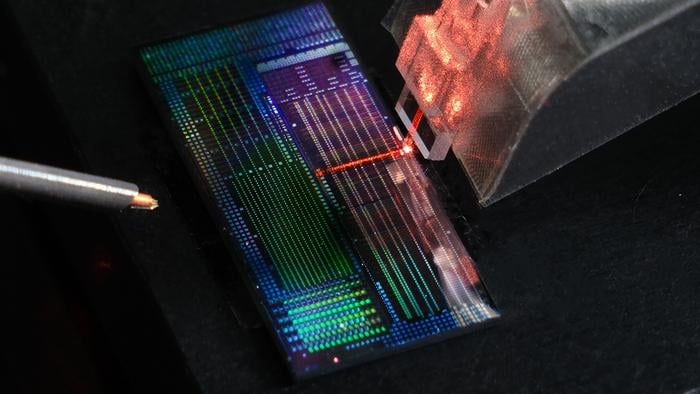
This article explores the design, manufacturing, and profound implications of this tiny chip, detailing how its integration of high performance, low power consumption, and scalable production could unlock the next generation of quantum information processing.
The Core Innovation: A Scalable Optical Phase Modulator
At the heart of this advancement is a new type of optical phase modulator. Its primary function is to manipulate laser light with remarkable precision, a capability essential for interacting with the quantum bits, or qubits, that form the basis of quantum computation. The device achieves this through microwave-frequency vibrations that oscillate billions of times per second, allowing it to generate new, stable laser frequencies efficiently.
What sets this device apart is its trifecta of advantages: miniature size, high performance, and drastically reduced power requirements. As reported by the research team led by Jake Freedman and Professor Matt Eichenfield, the chip uses approximately 80 times less microwave power than many existing commercial modulators. This reduction in power consumption directly translates to less heat generation, a critical factor when envisioning thousands of these devices packed onto a single chip to control a massive array of qubits.
Why Precision Lasers Are Quantum Computing's Linchpin
The role of ultra-precise lasers in quantum computing cannot be overstated. In leading quantum architectures that use trapped ions or neutral atoms, each atom serves as a qubit. To perform calculations, researchers must instruct these atoms by directing meticulously tuned laser beams at them. The required precision is staggering, sometimes needing adjustments to within billionths of a percent.
"Creating new copies of a laser with very exact differences in frequency is one of the most important tools for working with atom- and ion-based quantum computers," explained Jake Freedman. However, the current method relies on large, table-top systems that consume substantial power and space. These are feasible for small-scale experiments but become utterly impractical for the scale required by future quantum computers, which may need to coordinate hundreds of thousands of qubits.
The Manufacturing Breakthrough: CMOS Fabrication
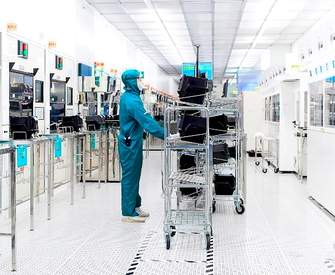
Perhaps the most revolutionary aspect of this device is how it is made. Instead of relying on custom, hand-assembled laboratory equipment, the researchers manufactured the chip entirely in a standard semiconductor fabrication facility, or fab. This process, known as CMOS (Complementary Metal-Oxide-Semiconductor) fabrication, is the same technology used to produce the billions of transistors in modern computer processors and smartphones.
"CMOS fabrication is the most scalable technology humans have ever invented," stated Professor Matt Eichenfield. By leveraging this existing, high-volume manufacturing infrastructure, the path is cleared to produce thousands or even millions of identical photonic devices cost-effectively. Nils Otterstrom of Sandia National Laboratories described this shift as moving optics "away from the optical equivalent of vacuum tubes and towards scalable integrated photonic technologies."
Implications for the Future of Quantum Computing
The implications of this research are profound. By solving the problems of size, power, and manufacturability simultaneously, this chip addresses a fundamental bottleneck. It enables the vision of quantum computers with exponentially more qubits than is currently possible. The lower heat output allows for dense integration, while the scalable manufacturing means these components can be produced reliably and in volume.
The research team is already building on this success, working towards fully integrated photonic circuits that combine frequency generation, filtering, and pulse shaping on a single chip. The next step involves partnering with quantum computing companies to test these chips inside advanced trapped-ion and trapped-neutral-atom systems. "This device is one of the final pieces of the puzzle," Freedman noted. "We're getting close to a truly scalable photonic platform capable of controlling very large numbers of qubits."

Conclusion
The development of this microchip-sized optical phase modulator marks a pivotal moment in quantum computing's journey from laboratory curiosity to scalable technology. By marrying precise laser control with the power of mass-production semiconductor manufacturing, researchers have provided a key enabler for the next leap forward. This work, supported by the U.S. Department of Energy's Quantum Systems Accelerator, demonstrates that the future of quantum computing may not be built on optical tables in warehouses, but on tiny, efficient chips rolling off the same production lines that power our digital world today. The era of large-scale, practical quantum machines has just become significantly more attainable.