Banksy's Powerful Protest Mural: Judge Beating Protester Outside London Court
A new Banksy mural depicting a judge in traditional wig and gown beating a fallen protester with a gavel has appeared outside a London courthouse. The striking artwork shows a blood-splattered protester lying on the ground holding a placard while being assaulted by judicial authority. This powerful piece continues Banksy's tradition of social commentary through street art, appearing strategically near a legal institution to amplify its message about justice system brutality and protest rights.
A new Banksy mural has emerged outside a London courthouse, creating immediate buzz and social commentary through its powerful visual narrative. The artwork depicts a judge in traditional wig and black gown violently beating a fallen protester with a gavel, while the protester lies on the ground holding a blood-splattered placard. This striking piece continues Banksy's long tradition of using public spaces to critique social and political systems.
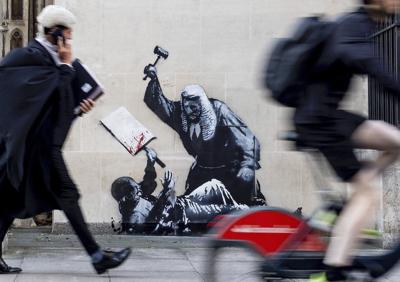
The mural's location outside a functioning courthouse adds layers of meaning to the artwork. By placing this critique of judicial violence directly adjacent to the institution it comments upon, Banksy creates an immediate dialogue between art and authority. The choice of location ensures that lawyers, judges, defendants, and court visitors all encounter this powerful statement about the justice system's potential for brutality.
Visual Symbolism and Social Commentary
Banksy's mural employs rich symbolism to convey its message about power dynamics and protest rights. The judge's traditional attire represents established authority and legal tradition, while the gavel—typically a symbol of order and judgment—becomes a weapon of violence. The fallen protester with blood-splattered placard symbolizes the vulnerability of dissent and the physical cost of challenging authority.

The blood-splattered placard held by the protester suggests that the very tools of peaceful protest—signs and demonstrations—become targets of violence. This imagery resonates with contemporary concerns about police brutality and the suppression of protest movements worldwide. Banksy's work often reflects current social tensions, and this piece appears during ongoing debates about protest rights and police powers.
Banksy's Tradition of Legal System Critique
This latest work continues Banksy's ongoing engagement with legal and justice themes. The anonymous artist has frequently used the British legal system as both subject and context for artworks, sometimes creating pieces that directly interact with law enforcement and legal proceedings. The courthouse location follows Banksy's pattern of placing art where it will have maximum contextual impact and public visibility.
The mural's appearance also raises questions about public art, vandalism laws, and the boundaries of political expression. Banksy's works often exist in a legal gray area, with some being protected as valuable art while others are removed as graffiti. This tension between artistic expression and property law becomes part of the artwork's meaning and impact.
As with many Banksy works, the mural has immediately attracted public attention and media coverage, becoming both an artistic statement and a cultural event. The piece continues the artist's pattern of creating works that are simultaneously accessible to the general public and rich with layered meanings for art critics and social commentators.