Read on the Guardian
Cathay Pacific's $40,000 Sydney-London Fare: A Sign of Global Air Travel Disruption
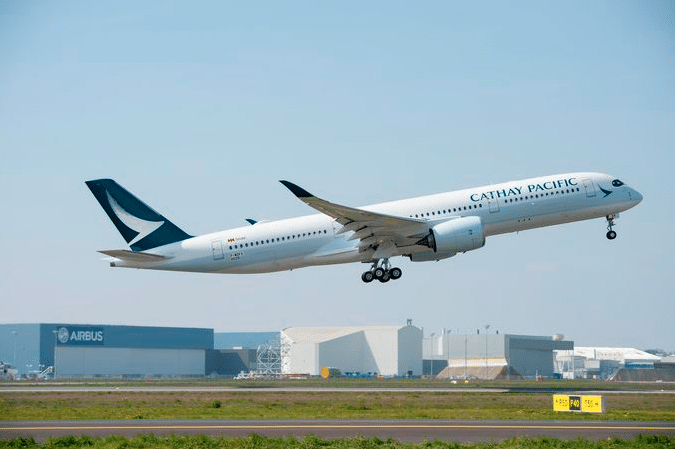
Cathay Pacific is selling business-class return tickets from Sydney to London for over A$39,500 in April, a price that far exceeds typical first-class fares. This extraordinary pricing is a direct result of the US-Israel war on Iran, which has closed critical airspace and major airport hubs in the Middle East. With a large portion of UK-Australia traffic normally connecting through the Gulf, travellers are scrambling for scarce alternative routes via Asia, leading to a severe supply-demand imbalance and skyrocketing prices on remaining long-haul flights that avoid the conflict zone.
The global aviation industry is experiencing unprecedented disruption, with fare volatility reaching extraordinary levels. A stark example is Cathay Pacific's listing of business-class return tickets from Sydney to London for A$39,577 (over £20,000) for travel in mid-April. This fare, reported by The Guardian, far exceeds what is typically charged for first-class travel on the same route, highlighting a severe short-term crisis in international air travel driven by geopolitical conflict.
The Root Cause: Middle East Airspace Closure
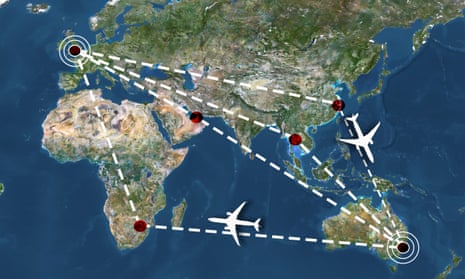
The primary driver of this fare surge is the US-Israel war on Iran, which has led to the closure of critical airspace and the partial or full shutdown of major airport hubs in the region for over ten days. This has had a domino effect on global connectivity. A significant proportion of traffic between the UK and Australia traditionally connects through Gulf hubs like Dubai (Emirates), Abu Dhabi (Etihad), and Doha (Qatar Airways). With these carriers operating at a fraction of their normal schedules and hundreds of thousands of flights cancelled, capacity has evaporated overnight.
The Scramble for Alternative Routes
Passengers are now forced to seek alternative long-haul connections that bypass the Middle East entirely. This has shifted demand to carriers operating via Asian hubs such as Singapore, Hong Kong, and Malaysia. However, these routes have inherently limited capacity, as they were not designed to handle the entire volume of traffic diverted from the Gulf corridor. The sudden, massive influx of demand for these limited seats has created a classic supply-demand imbalance, resulting in astronomical fares for the scarce premium cabins that remain.
Fare Comparisons and Market Volatility
The A$39,577 Cathay Pacific business-class fare is an extreme outlier. For context, return UK-Australia fares are more typically in the range of £3,000 to £4,000 for business class and from £800 for economy. Even first-class travel on the same Cathay Pacific route in April was listed at a "mere" A$28,146. The disruption has also inflated economy fares. While some Gulf-connecting economy tickets remain around £1,100, routes via China, India, and Malaysia are now listed between £1,400 and £1,800—prices that were at premium economy levels just a year ago. Aviation analyst Andrew Charlton noted that similar fare increases are being seen on other Asia-Europe routes from countries like the Philippines and Japan.
Broader Industry Implications
This event exposes the depth of the world's travel reliance on the Gulf corridor. The crisis is compounded by the pre-existing closure of Russian airspace, which had already made some northern Asian routes less viable. Airlines now face a double challenge: avoiding both Russian and Middle Eastern airspace. Some carriers from Japan are reportedly having to reroute flights northeast over Alaska and the Arctic to reach London, adding significant time and cost. A Cathay Pacific spokesperson acknowledged the "short-term supply-demand imbalance" and stated the airline is operating extra flights and responding with agility to meet evolving customer needs.
The current situation serves as a stark reminder of the fragility of global aviation networks in the face of geopolitical instability. While fares via the Gulf may appear cheaper, travellers are advised to exercise extreme caution and verify their travel insurance coverage, as schedules remain highly uncertain. The market is likely to experience continued volatility until stability returns to the region, underscoring the complex interplay between international politics, logistics, and consumer travel.